In short: In October 2026, we audited the homepages of 50 home-care agencies across 8 US cities, from Nashville to Phoenix to Tampa. The headline finding: 94% show no real photos of their teams or caregivers, only stock images, placeholders, or nothing at all. Two thirds publish no testimonials on the homepage, two thirds bury the phone number below the first screen, and 58% have no findable Google Business Profile with reviews. The surprise is what agencies got right: 94% use HTTPS and 96% have scannable headings, so the technology is largely solved and the real gap is trust.
Every home care website makes the same promise, whether it says it outright or not: trust us with the people you love most. A family choosing an agency is not shopping for a product. They are deciding who will be alone in the house with their mother, and a website is where that trust is built or lost in the first minute.
I have worked in home-care operations since 2019, and I have reviewed dozens of agency websites. Most advice about fixing them is guesswork, so we measured instead. We scored the homepages of 50 distinct agencies across Nashville, Columbus, Indianapolis, Raleigh, Phoenix, Dallas, Atlanta, and Tampa, a mix of independents, regional companies, hospital-affiliated agencies, and a few national franchises, on seven criteria from real photography to HTTPS.
Here is the finding I did not expect. The technical basics are in good shape: 94% load over HTTPS with no security warnings, 96% have proper heading structure and scannable text, and 92% show no heavy page signals like auto-playing videos or bloated sliders.
“The technical basics are largely solved: 94% of sites use HTTPS and 96% have scannable headings. The gap is not technology, it is trust: real photos, visible reviews, and an obvious way to call.”
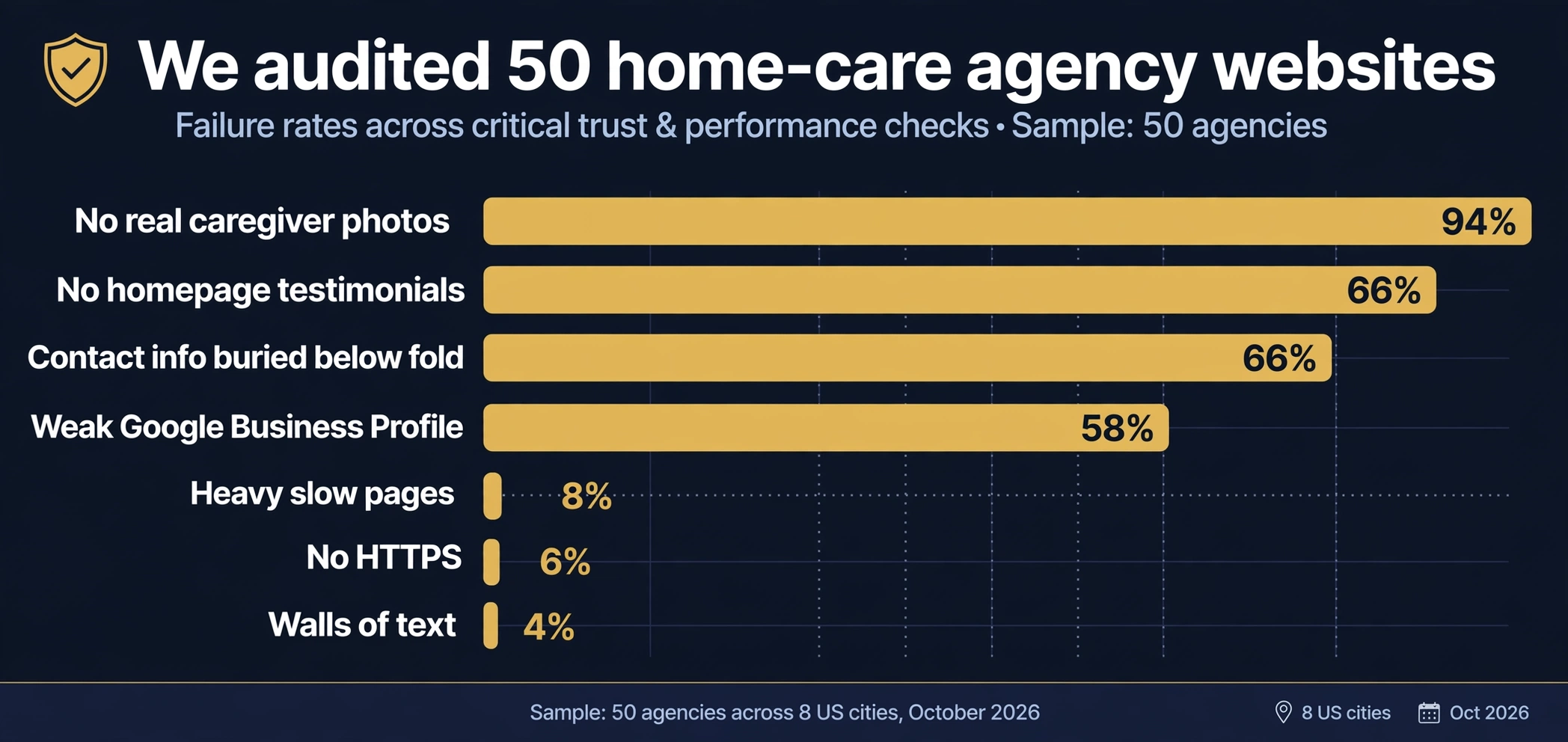
But trust is where nearly every site falls apart. 94% show no real team or caregiver photos. 66% show no testimonials where families land first. 66% make visitors scroll to find a phone number. 58% cannot be found on Google Maps with reviews. Agencies have fixed the plumbing and left the front door locked.
The stat: 47 out of 50 homepages show no real photos of the team or caregivers. Only 3 sites in the entire sample show actual people who work there.
What it looks like in practice: Stock filenames everywhere: shutterstock and Getty IDs, Unsplash downloads, AI-generated heroes, transparent placeholders, or no people at all. We judged photography from image filenames and alt text, cross-checking 7 sites against their About or Team pages. The pattern held.
What it costs: A family is deciding whether to let strangers into their parent’s home. When the “caregiver” on your homepage is the same stock model on three other agencies’ sites, trust drops instead of rising.
How to fix it:
The stat: 33 of 50 homepages show no testimonials or reviews. Only 34% do, so two out of three agencies lead with claims about themselves and no proof.
What it looks like in practice: Many sites have no review content near the homepage at all. Some bury testimonials on a separate page nobody visits. A few show a “Testimonials” heading with no quotes under it. We scored strictly: reviews had to be visible on the homepage itself.
What it costs: When two agencies look similar, reviews decide. A family comparing your site (zero visible reviews) against a competitor showing twenty Google reviews does not need long to choose.
How to fix it:
The stat: 33 of 50 homepages show no phone number or contact call-to-action above the fold. Families must scroll, sometimes past 60 to 140 lines of content, or dig into the footer.
What it looks like in practice: The typical pattern is a pretty hero section with a headline and no way to act on it. The phone number lives in the footer or on a separate contact page. We approximated “above the fold” as the first 40 lines of extracted page text, which is generous, and two thirds still failed.
“Two out of three agency homepages make a stressed family scroll to find a phone number. The inquiry form is the highest-leverage element on the page, and most sites bury it.”
What it costs: Nobody browsing for home care is relaxed. They are often calling from a hospital parking lot or late at night after a discharge notice. A family in crisis will not hunt for your contact details.
How to fix it:
The stat: 29 of 50 agencies had no findable Google Business Profile with reviews. For each agency we ran one web search combining the agency name, city, and home care reviews, and only a visible Google Maps or business listing with reviews scored a pass.
What it looks like in practice: For searches like “home care agency near me,” Google shows a map with three agencies before any website. More than half the agencies we checked are effectively absent from that box, or present without reviews, photos, or correct hours.
What it costs: The map box is where ready-to-call families decide. If you are not in it, you are invisible at the exact moment of decision.
How to fix it:
Beyond HTTPS (94%) and scannable headings (96%), only 8% of sites showed heavy page signals. One honest caveat: our speed check was a proxy, not a real load test, so the true number of slow sites is probably higher. The bar has moved from “does the site work” to “does the site earn trust.”
One finding deserves its own line: 2 of the 50 sites, both in Atlanta, failed to load entirely. That is 4% of agencies effectively unreachable online. A website that does not load is a closed front door.
“We audited 50 home-care agency websites across 8 US cities. 94% show no real photos of their caregivers. Families are asked to trust strangers with their parents, and the websites show them stock photos.”
Each homepage was fetched as text and scored on seven criteria: real team or caregiver photography, testimonials on the homepage, phone or contact call-to-action above the fold, findable Google Business Profile with reviews, heavy page signals, HTTPS, and scannable headings. Photography was judged from image filenames and alt text, with 7 sites cross-checked against their About or Team pages. Google presence was judged from one web search per agency.
Honest limitations: we did not render pages in a browser, so above-the-fold is an approximation, not a measurement. Mobile speed was a proxy (visible bloat signals), not a PageSpeed test, so the 92% pass rate likely overstates reality. Photo judgments from filenames carry some uncertainty. The sample is a convenience sample found via web search, not a random sample of the US market, and the first 10 agencies came from an existing lead list filtered for weak websites. A sensitivity check excluding those 10 (n = 40) shows the same ranking. The pattern is robust. One scoring correction was applied during review when a site’s evidence notes contradicted its social proof score.
How were these 50 agencies chosen?
Through web searches across 8 US cities in October 2026: independents, regional companies, hospital-affiliated agencies, and a few franchises. A convenience sample, not a random one.
How can you judge “above the fold” without seeing the pages?
We approximated it as the first 40 lines of extracted page text containing a visible phone number or contact call-to-action. That is generous to the sites, and two thirds still failed.
Is stock photography really that harmful?
For most businesses it is harmless decoration. Home care is different because the product is trust in strangers. When a family sees the same stock “caregiver” on multiple agency sites, it signals nothing on the page is real. Real team photos are the single highest-leverage trust fix in this data.
Will fixing these issues actually bring more inquiries?
This audit measures how common each problem is, not the exact inquiry lift from fixing it. But each failure maps to well-established conversion research: visible contact paths, social proof, and page speed consistently lift inquiries for local services. The fixes are cheap, most are free, so the risk of acting is low.
Start with the trust gap, not a redesign. Photograph your real team this week. Put three reviews and your phone number at the top of your homepage. Claim your Google Business Profile. Those four moves address the four most common failures in this audit, and none requires rebuilding your site.
If you would like a second pair of eyes, Web Services Logix will build you a free demo homepage for your home-care agency, designed around exactly these findings: real photography, visible reviews, and a contact path nobody has to hunt for. You only pay if you love it.
About the author: Ahmad Raza is a Top Rated web designer on Upwork with a 5.0 rating across 29 reviews. He has worked in home-care operations since 2019, designing agency websites around how families actually search, compare, and choose care.