By Ahmad Raza, Top Rated on Upwork with a 5.0 rating across 29 reviews, in home-care operations since 2019.
If you've searched for "home care website cost" and found nothing but vague ranges, you're not alone. Ask five web designers what a home care website costs and you'll get five shrugs and one sales call. Agencies publish everything else, service lists, caregiver bios, holiday photos, but the price of the website itself stays a mystery.
So I did the boring work: 7 real, attributed prices. Four published DIY builder plans, real Fiverr marketplace prices, published freelancer rates, and published agency ranges.
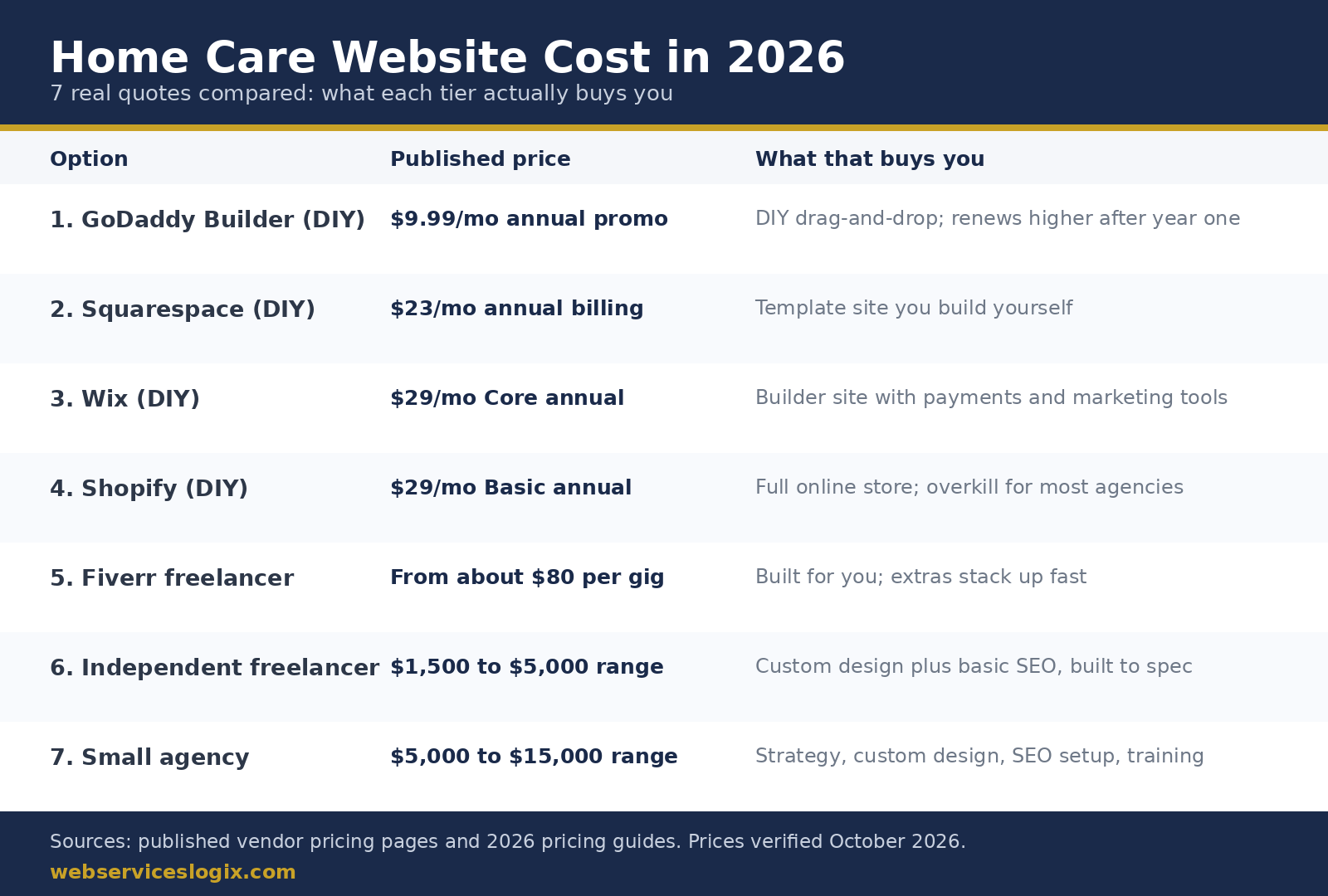
| # | Option | Published price | What that buys you |
|---|---|---|---|
| 1 | GoDaddy Website Builder (DIY) | $9.99/month on annual promo billing | DIY drag-and-drop; renews higher after year one |
| 2 | Squarespace (DIY) | $23/month on annual billing | Template site you build yourself, no Squarespace branding |
| 3 | Wix (DIY) | $29/month on annual billing (Core plan) | Builder site with payments and marketing tools included |
| 4 | Shopify (DIY) | $29/month on annual billing (Basic plan) | Full online store; overkill for most agencies |
| 5 | Fiverr freelancer | From about $80 per gig; Fiverr's own guide says $500 to $10,000 per project | Built for you; extras stack up fast |
| 6 | Independent freelancer | Market range: $1,500 to $5,000 for a small business site | Custom design with basic SEO, built to your spec |
| 7 | Small web design agency | Published range: $5,000 to $15,000 for a small business site | Strategy, custom design, development, SEO setup, training |
GoDaddy's published pricing (verified August 2026 by howtostartanllc.com) lists Basic at $9.99/month and Premium at $14.99/month on annual billing: the cheapest entry here. But these are promo rates that renew higher (Premium roughly doubles to about $30/month), the free domain needs an annual plan, and the cheapest tier parks you on a GoDaddy subdomain until you pay. Fine on a shoestring, but you're renting the site forever with no export button.
Multiple 2026 pricing reviews list the Squarespace Business plan at $23/month on annual billing ($276 a year), removing Squarespace branding and unlocking the marketing tools most businesses need. The templates are beautiful, but the trade-off is control. Squarespace covers SEO basics (titles, meta descriptions, alt text) yet limits the advanced controls that matter for local search, like schema markup and redirects. Families find agencies through Google Maps and local search, where a template can quietly hold you back. (Plan names and prices have been shifting, so verify the current page before budgeting.)
Wix's own 2026 pricing explainer (wix.com, August 2026) lists Core at about $29/month on annual billing, Business at $39/month, and Light at $17/month. For home care, Core is the realistic pick: the entry point for payments and booking, with 50 GB of storage. Three years on Core costs $1,044 in subscription fees alone, and like every builder, Wix rents you the platform every month forever, with no export button if you leave.
Shopify's Basic plan is listed at $29/month on annual billing ($39 month-to-month), per Shopify's own pricing page as of October 1, 2026 (reported by bushe.co). It's a superb ecommerce platform that most home care agencies don't need. Unless you're selling care packages or gift cards online, a full online store adds complexity and cost without adding a single client, because a home care website's one job is generating inquiries. Included here because cost roundups always mention it; the honest answer for agencies is skip it.
A 2026 study of top-ranked Fiverr gigs found the median Basic price for website gigs was $80, and reviewer blaksheepcreative.com (updated September 2026) found established website-design sellers start around $80 to $100, Top Rated sellers around $90 to $100, and Vetted Pros from $195 to $600. Fiverr's own cost guide puts freelance web design generally at $500 to $10,000 per project.
The listed price is the floor, not the total: mobile layout, extra pages, working contact forms, and speed optimisation are usually add-ons, and no gig tier includes keyword research or page architecture, which decides whether your site earns anything. Fine for bounded, disposable work.
Labelled honestly as a market range: 2026 pricing guides (wpzoom.com, mediasearchgroup.com) put a freelancer-built small business website at $1,500 to $5,000, with hourly rates around $50 to $150. You get custom design, a proper inquiry form, basic on-page SEO, mobile responsiveness, and a few revision rounds, but usually not copywriting (budget $50 to $500 per page, per DesignRush) or ongoing maintenance. For home care, this is where the maths starts working: one new private-pay client can be worth thousands a year, so a $3,000 site that brings two extra clients has paid for itself many times over.
Sayenko Design's 2026 price guide puts "a solid website from a small agency" at $5,000 to $15,000, while DesignRush data via duck.design puts a small business site of up to 20 pages at $2,000 to $8,000. You're buying a team: strategy, design, development, SEO setup, and training. The honest question is whether you need that team. Most home care agencies need a fast, trustworthy, local-SEO-friendly site with a great inquiry form, not a brand campaign. If an agency quotes you $12,000, ask which parts of that scope generate client inquiries, because that's the only part that matters.
| DIY builders | Fiverr gig | Freelancer | Agency | |
|---|---|---|---|---|
| Design | Template, you pick | Template-based, lightly customised | Custom or heavily customised template | Fully custom |
| Pages | Unlimited, you write them | 3 to 5 in the base gig | 5 to 15 typical | 10 to 20 typical |
| Copywriting | You write it | Rarely included | Sometimes, often extra | Usually included or quoted |
| SEO | Built-in basics only | Rarely included | Basic on-page setup | Technical + content SEO |
| Revisions | Unlimited (it’s you) | 1 to 2 in the base gig | 2 to 3 typical | Defined rounds, often generous |
| Support | Platform support chat | Usually none after delivery | 14 to 30 days typical | 30 to 90 days typical |
| Timeline | A weekend, if you're fast | 3 to 7 days typical | 1 to 3 weeks | 4 to 8 weeks |
See the pattern? As the price rises, you're not buying more pages. You're buying thinking: someone who decides what goes on each page and why. For home care, that thinking beats design polish, because families choose on trust signals, which our 50-site audit found most agencies missing.
Just launched, no clients yet? Start with a DIY builder. Get something live this week, claim your Google Business Profile, and spend your energy on your first families. You can rebuild later; you can't get back months with no website.
Operating, but the phone isn't ringing? Don't buy a prettier template. Your problem is almost certainly one of the seven mistakes that cost agencies inquiries: a buried contact form, slow mobile load, no reviews on the page. Run our free scorecard quiz first. You might need a $200 fix, not a $5,000 rebuild.
Growing and want the site to pull its weight? Go mid tier: a freelancer or niche specialist who understands how families choose care. Custom design, real SEO basics, an inquiry form built for 11pm crisis searches. That's where the site starts earning its keep.
The quotes above don't show hidden costs. Budget for a domain ($10 to $50 a year), the renewal jump on builder promo prices, copywriting if you can't write it yourself, and maintenance ($500 to $2,000 a year per DesignRush). Whatever tier you pick, ask what's included before you sign anything.
What's the cheapest way to get a home care website in 2026?
A DIY builder. GoDaddy's Basic plan is listed at $9.99/month on annual promo billing and Wix's Light plan at $17/month: roughly $120 to $350 a year plus your time. You write the copy, you handle the SEO basics, and you can't take the site with you if you leave.
How much does a custom home care website cost from a freelancer?
Published 2026 market ranges put a freelancer-built small business website at $1,500 to $5,000, with hourly rates around $50 to $150. Expect the middle of that range for a 5 to 10 page home care site with custom design, a proper inquiry form, and basic on-page SEO.
Is it worth paying an agency $10,000 for a home care website?
Only if the scope justifies it. Published agency ranges run $5,000 to $15,000: you're buying strategy plus a team. Most home care agencies don't need a $10,000 site; they need a fast, trustworthy site with strong local SEO and a great inquiry form, which the mid tier delivers for far less.
Do I need ecommerce like Shopify for my home care agency?
Almost certainly not. Shopify's Basic plan is $29/month on annual billing, but it's built for selling products online, while a home care website's job is generating phone calls and form inquiries. Put the money into your Google Business Profile and reviews instead.
Want to see what a custom site could look like for your agency? Web Services Logix will build you a free demo homepage. You only pay if you love it: no deposit, no pressure. Get in touch here.
About the author: Ahmad Raza is a Top Rated web designer on Upwork with a 5.0 rating across 29 reviews. He's worked in home-care operations since 2019, so he designs agency websites around how families actually search, compare, and choose care.
In short: In October 2026, we audited the homepages of 50 home-care agencies across 8 US cities, from Nashville to Phoenix to Tampa. The headline finding: 94% show no real photos of their teams or caregivers, only stock images, placeholders, or nothing at all. Two thirds publish no testimonials on the homepage, two thirds bury the phone number below the first screen, and 58% have no findable Google Business Profile with reviews. The surprise is what agencies got right: 94% use HTTPS and 96% have scannable headings, so the technology is largely solved and the real gap is trust.
Every home care website makes the same promise, whether it says it outright or not: trust us with the people you love most. A family choosing an agency is not shopping for a product. They are deciding who will be alone in the house with their mother, and a website is where that trust is built or lost in the first minute.
I have worked in home-care operations since 2019, and I have reviewed dozens of agency websites. Most advice about fixing them is guesswork, so we measured instead. We scored the homepages of 50 distinct agencies across Nashville, Columbus, Indianapolis, Raleigh, Phoenix, Dallas, Atlanta, and Tampa, a mix of independents, regional companies, hospital-affiliated agencies, and a few national franchises, on seven criteria from real photography to HTTPS.
Here is the finding I did not expect. The technical basics are in good shape: 94% load over HTTPS with no security warnings, 96% have proper heading structure and scannable text, and 92% show no heavy page signals like auto-playing videos or bloated sliders.
“The technical basics are largely solved: 94% of sites use HTTPS and 96% have scannable headings. The gap is not technology, it is trust: real photos, visible reviews, and an obvious way to call.”
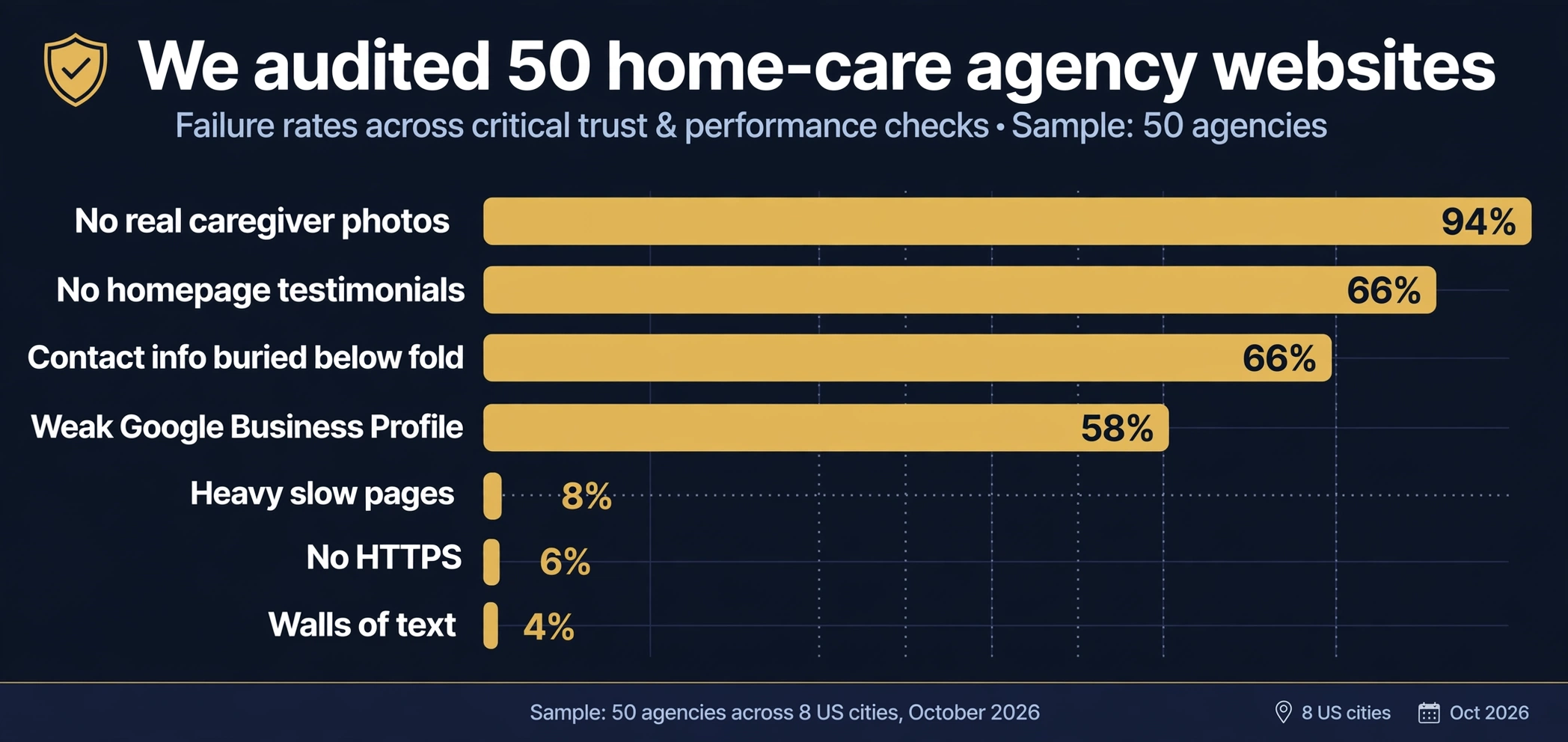
But trust is where nearly every site falls apart. 94% show no real team or caregiver photos. 66% show no testimonials where families land first. 66% make visitors scroll to find a phone number. 58% cannot be found on Google Maps with reviews. Agencies have fixed the plumbing and left the front door locked.
The stat: 47 out of 50 homepages show no real photos of the team or caregivers. Only 3 sites in the entire sample show actual people who work there.
What it looks like in practice: Stock filenames everywhere: shutterstock and Getty IDs, Unsplash downloads, AI-generated heroes, transparent placeholders, or no people at all. We judged photography from image filenames and alt text, cross-checking 7 sites against their About or Team pages. The pattern held.
What it costs: A family is deciding whether to let strangers into their parent’s home. When the “caregiver” on your homepage is the same stock model on three other agencies’ sites, trust drops instead of rising.
How to fix it:
The stat: 33 of 50 homepages show no testimonials or reviews. Only 34% do, so two out of three agencies lead with claims about themselves and no proof.
What it looks like in practice: Many sites have no review content near the homepage at all. Some bury testimonials on a separate page nobody visits. A few show a “Testimonials” heading with no quotes under it. We scored strictly: reviews had to be visible on the homepage itself.
What it costs: When two agencies look similar, reviews decide. A family comparing your site (zero visible reviews) against a competitor showing twenty Google reviews does not need long to choose.
How to fix it:
The stat: 33 of 50 homepages show no phone number or contact call-to-action above the fold. Families must scroll, sometimes past 60 to 140 lines of content, or dig into the footer.
What it looks like in practice: The typical pattern is a pretty hero section with a headline and no way to act on it. The phone number lives in the footer or on a separate contact page. We approximated “above the fold” as the first 40 lines of extracted page text, which is generous, and two thirds still failed.
“Two out of three agency homepages make a stressed family scroll to find a phone number. The inquiry form is the highest-leverage element on the page, and most sites bury it.”
What it costs: Nobody browsing for home care is relaxed. They are often calling from a hospital parking lot or late at night after a discharge notice. A family in crisis will not hunt for your contact details.
How to fix it:
The stat: 29 of 50 agencies had no findable Google Business Profile with reviews. For each agency we ran one web search combining the agency name, city, and home care reviews, and only a visible Google Maps or business listing with reviews scored a pass.
What it looks like in practice: For searches like “home care agency near me,” Google shows a map with three agencies before any website. More than half the agencies we checked are effectively absent from that box, or present without reviews, photos, or correct hours.
What it costs: The map box is where ready-to-call families decide. If you are not in it, you are invisible at the exact moment of decision.
How to fix it:
Beyond HTTPS (94%) and scannable headings (96%), only 8% of sites showed heavy page signals. One honest caveat: our speed check was a proxy, not a real load test, so the true number of slow sites is probably higher. The bar has moved from “does the site work” to “does the site earn trust.”
One finding deserves its own line: 2 of the 50 sites, both in Atlanta, failed to load entirely. That is 4% of agencies effectively unreachable online. A website that does not load is a closed front door.
“We audited 50 home-care agency websites across 8 US cities. 94% show no real photos of their caregivers. Families are asked to trust strangers with their parents, and the websites show them stock photos.”
Each homepage was fetched as text and scored on seven criteria: real team or caregiver photography, testimonials on the homepage, phone or contact call-to-action above the fold, findable Google Business Profile with reviews, heavy page signals, HTTPS, and scannable headings. Photography was judged from image filenames and alt text, with 7 sites cross-checked against their About or Team pages. Google presence was judged from one web search per agency.
Honest limitations: we did not render pages in a browser, so above-the-fold is an approximation, not a measurement. Mobile speed was a proxy (visible bloat signals), not a PageSpeed test, so the 92% pass rate likely overstates reality. Photo judgments from filenames carry some uncertainty. The sample is a convenience sample found via web search, not a random sample of the US market, and the first 10 agencies came from an existing lead list filtered for weak websites. A sensitivity check excluding those 10 (n = 40) shows the same ranking. The pattern is robust. One scoring correction was applied during review when a site’s evidence notes contradicted its social proof score.
How were these 50 agencies chosen?
Through web searches across 8 US cities in October 2026: independents, regional companies, hospital-affiliated agencies, and a few franchises. A convenience sample, not a random one.
How can you judge “above the fold” without seeing the pages?
We approximated it as the first 40 lines of extracted page text containing a visible phone number or contact call-to-action. That is generous to the sites, and two thirds still failed.
Is stock photography really that harmful?
For most businesses it is harmless decoration. Home care is different because the product is trust in strangers. When a family sees the same stock “caregiver” on multiple agency sites, it signals nothing on the page is real. Real team photos are the single highest-leverage trust fix in this data.
Will fixing these issues actually bring more inquiries?
This audit measures how common each problem is, not the exact inquiry lift from fixing it. But each failure maps to well-established conversion research: visible contact paths, social proof, and page speed consistently lift inquiries for local services. The fixes are cheap, most are free, so the risk of acting is low.
Start with the trust gap, not a redesign. Photograph your real team this week. Put three reviews and your phone number at the top of your homepage. Claim your Google Business Profile. Those four moves address the four most common failures in this audit, and none requires rebuilding your site.
If you would like a second pair of eyes, Web Services Logix will build you a free demo homepage for your home-care agency, designed around exactly these findings: real photography, visible reviews, and a contact path nobody has to hunt for. You only pay if you love it.
About the author: Ahmad Raza is a Top Rated web designer on Upwork with a 5.0 rating across 29 reviews. He has worked in home-care operations since 2019, designing agency websites around how families actually search, compare, and choose care.
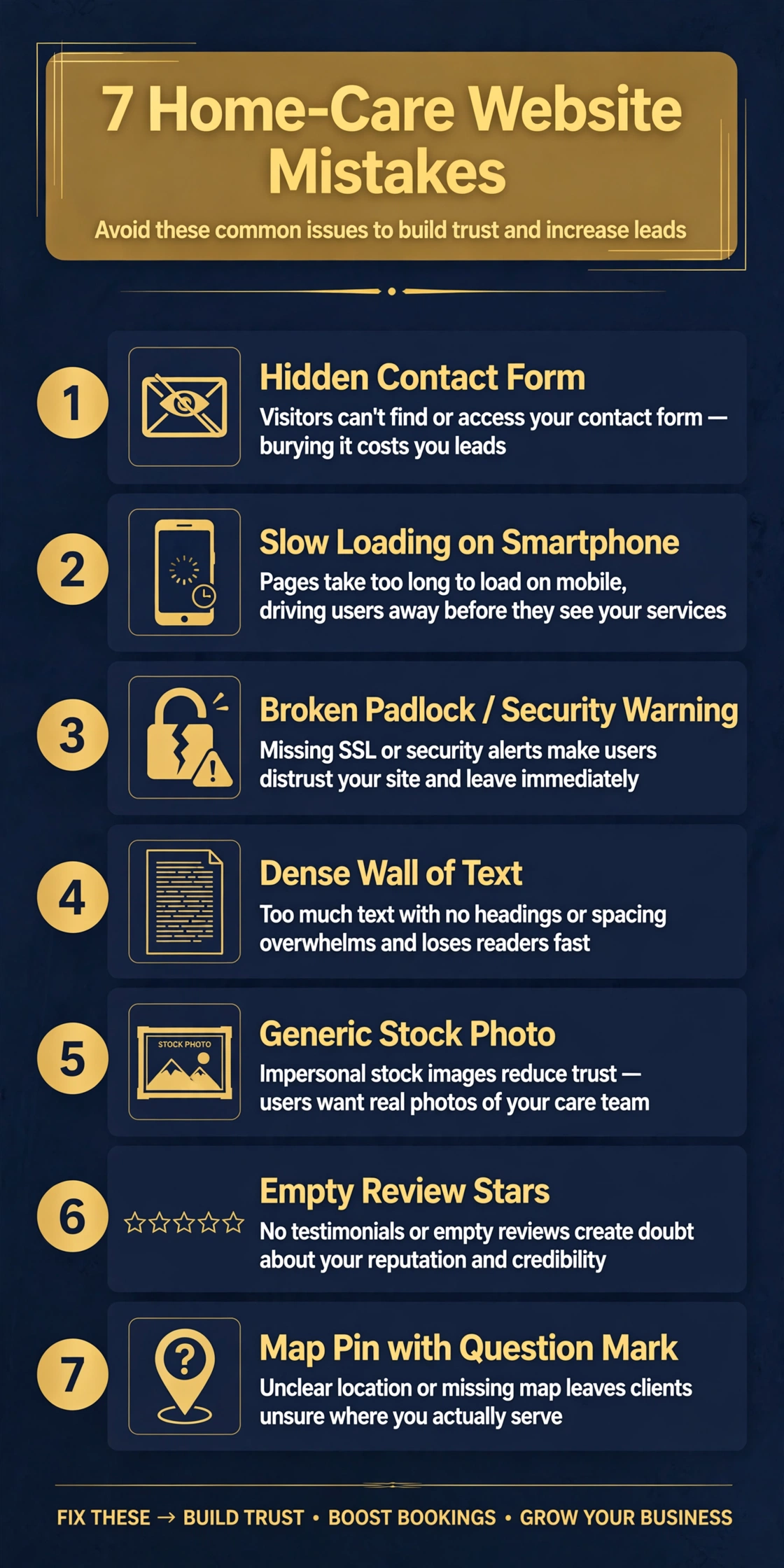
In short: Most home care websites lose inquiries to the same seven mistakes: no inquiry form above the fold, slow mobile load times, missing SSL security, pages of dense text nobody reads, stock photos instead of real caregivers, no visible reviews, and a neglected Google Business Profile. Each one quietly sends families to a competitor. Every fix below is simple, most are free, and agencies usually see more inquiries within weeks.
Your home care website is the first impression most families get of your agency. They are not browsing for fun. They are usually stressed, short on time, and choosing between you and two other agencies. I have worked in home-care operations since 2019 and reviewed dozens of agency websites, and the same seven mistakes keep showing up. Here is what each one costs you and how to fix it.
Picture this. It is 11 pm. A daughter has just learned her father is being discharged from the hospital in the morning and needs a caregiver starting tomorrow. She searches, finds your site, and sees a nice headline. But there is no phone number or contact form on the screen. She would have to scroll to find one. She does not scroll. She hits the back button and calls the next agency, whose number is right there at the top.
A family in crisis will not hunt for your contact details.
How to fix it:
Google’s research found that 53 percent of mobile visits are abandoned when a page takes longer than three seconds to load. More than half of your visitors may never even see your homepage.
Now picture a son sitting in a hospital parking lot on a weak signal, comparing two agencies. Your site shows a blank screen for six seconds while a slideshow loads. The competitor’s site is already up. Guess who gets the call.

How to fix it:
Open your site in Chrome. If the address bar says “Not secure” instead of showing a padlock, you have no SSL certificate. Browsers now warn visitors outright, and some show a full-page warning before the site even loads.
Imagine a family member who has finally decided to fill out your inquiry form. Just as they start typing their phone number, the browser warns them the connection is not secure. They close the tab.
How to fix it:
Research from Stanford found that people form an opinion about a website in about 50 milliseconds. Fifty. Your visitors are not reading; they are scanning for one thing: can this agency help my family?
Now picture the wife of a stroke patient, reading on her phone at midnight. She lands on a page with five long paragraphs about the agency’s history and mission. She cannot find the services list, the service area, or the phone number. She leaves.
How to fix it:
Here is an uncomfortable truth about home care website design: many agency sites use the same handful of stock photos. Families notice. When the same smiling “caregiver” appears on three different agency websites, trust drops instead of rising. Families are inviting someone into their parent’s home. They want to see real people.
How to fix it:
When a family is choosing between two agencies that look similar, reviews decide. The large majority of people now read reviews before contacting a local service, and home care is no exception. If your site shows zero testimonials while a competitor shows twenty Google reviews, the decision makes itself.
How to fix it:
For searches like “home care agency near me,” Google shows a map with three agencies before it shows any website. That map box is fed by your Google Business Profile. If your profile is unclaimed, has no photos, no reviews, and the wrong hours, you are invisible exactly when a family is ready to call.
How to fix it:
The page loads fast, it is secure, the phone number and a short form are visible immediately, the text is scannable, the photos show real people, reviews prove you deliver, and your Google profile makes you findable. None of this requires fancy design. It requires respecting how families actually behave when they need help.
How much does it cost to fix these website mistakes?
Most fixes above are free: SSL, image compression, rewriting text, and claiming your Google profile cost nothing but time. A full redesign of a home care agency website typically runs a few hundred dollars if you hire it out.
Do I need a brand-new website, or can I fix the one I have?
Fix first. The form placement, speed, SSL, and photo changes work on almost any site. Consider a rebuild only if your site is not mobile-friendly at all or runs on software you can no longer update.
How long until I see more inquiries?
Speed, security, and form fixes can lift inquiries within two to four weeks. Google Business Profile and review improvements compound over two to three months. Content changes that help you rank on Google take longer, usually three to six months.
What is the single most important fix on this list?
Make it effortless to contact you. A visible phone number and a short form above the fold, on every page, will do more for your inquiry numbers than anything else here.
If you would like a second pair of eyes on your site, Web Services Logix will build you a free demo homepage for your home-care agency. You only pay if you love it. There is no deposit and no pressure.
About the author: Ahmad Raza is a Top Rated web designer on Upwork with a 5.0 rating across 29 reviews. He has worked in home-care operations since 2019, so he designs agency websites around how families actually search, compare, and choose care.